
Commissioning art on Mihuashi starts with a step most guides gloss over: you can't hire an artist until your account actually has funds. Mihuashi is an art-commission marketplace run by Beijing Qixin Technology, launched in 2016 and focused on game and anime-style illustration. Its defining mechanic is escrow: the client parks a deposit with the platform, the artist delivers in four checkpoints — sketch, line art, color, final — and the platform releases a portion of the funds each time the client signs off. It's a genuinely good system for preventing scams on both sides, but it creates a hard prerequisite: money in the account first.
1. Three Things to Understand Before You Top Up
Your verification status sets your ceiling
Mihuashi limits unverified accounts on both per-transaction and cumulative top-ups; published guidance puts the cap at RMB 500. Once identity verification is complete, that ceiling lifts to whatever your payment channel allows. If you plan to commission regularly, finish verification first — it also affects whether artists will work with you. Many artists decline unverified clients outright.
The official side only speaks RMB
This is the wall most overseas users hit. Mihuashi prices and settles in Chinese yuan, and its native payment rails sit inside the mainland system. Foreign-issued credit cards, PayPal, and most regional wallets outside mainland China won't connect directly. If you live abroad and only hold a foreign currency card or a local e-wallet, the payment step simply doesn't have an entry point.
The platform takes a cut on the artist's side
Mihuashi charges 5% of the completed commission as a transaction fee, deducted at the moment the deal closes, not at withdrawal. That cost falls on the artist, not on your top-up, but it shapes what you should consider a fair price — the quote you receive already has that 5% baked into it.
2. The Three Routes to a Mihuashi Balance
Official top-up: cleanest, but mainland-only
In the app or on the website, go to Personal Center → Funds → Top Up, enter the amount, and jump to the official payment page. The advantages are obvious: shortest path, fastest arrival, clearest fund attribution. The downside is equally obvious — it requires mainland Chinese payment tools, which most overseas buyers don't have.
QR-code proxy payment: you generate, they scan
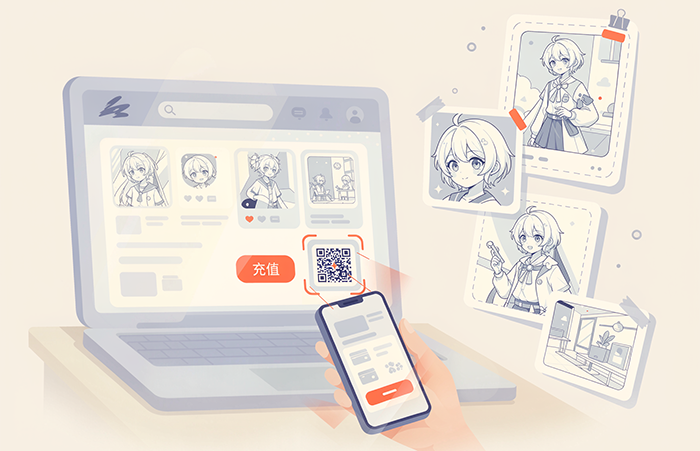
You place the order on Mihuashi's official site normally and stop at the step where the payment QR code is generated. You screenshot that code and hand it to a proxy payer, who scans it to complete the payment. You never hand over your account password. The proxy only ever touches a single-use payment link. This route is materially safer than login-based top-up because your credentials never leave your control and no third party ever holds your session.
Login-based top-up: handing your account to an agent
An agent logs into Mihuashi with the account and password you provide and tops up on your behalf. It's fast, but the cost is real: you're temporarily transferring control of your account to someone else. If this is your only option, verify the platform's operating history and reputation first, change your password before and immediately after, and enable two-factor authentication.
3. Topping Up Through 94LIVES, Step by Step
94LIVES addresses the actual pain point for overseas buyers: it removes the need to figure out cross-border transfers or currency exchange yourself, and replaces it with payment methods you already use.
Step 1 — Pick a denomination
Mihuashi products are listed in RMB tiers, typically ranging from RMB 100 to RMB 5,000. Pick a tier that matches the commission and deposit you're planning. There's no need to stockpile — a Mihuashi balance isn't an investment, and you can top up again whenever you need to.
Step 2 — Choose a payment method
This is where overseas users see the real benefit. 94LIVES aggregates multi-currency settlement with globally mainstream payment rails, so you pay in the currency and method you're already comfortable with. No wire transfers, no manual FX. Double-check the amount and account details before submitting — top-up transactions that go to the wrong account are generally irreversible.
Step 3 — Contact support for the proxy payment
Once payment is complete, send the unpaid Mihuashi order QR code to 94LIVES online support and an agent will scan it; alternatively, follow the agent's instructions to provide login details. Support is staffed 24/7, and your balance typically updates within a minute of successful payment.
Step 4 — Verify the balance on Mihuashi
Log back in and confirm the balance, noting the pre-top-up state so you can compare. If it doesn't update right away, match your order number against the agent's records.
4. Pricing Reference
Mihuashi prices in RMB, while third-party platforms settle in your local currency. Those prices float with the exchange rate and the cost of the payment channel, so they aren't fixed quotes. Here is the USD reference table 94LIVES publishes — always confirm the live quote on the product page before ordering:
| RMB Amount | USD Price |
|---|---|
| 100 RMB | 15.20 USD |
| 200 RMB | 30.80 USD |
| 500 RMB | 76.99 USD |
| 1000 RMB | 156.98 USD |
| 2000 RMB | 312.96 USD |
| 5000 RMB | 794.89 USD |
Reference prices published on the 94LIVES page. Actual pricing fluctuates with exchange rates and channel costs; check the live quote on the product page.
5. Pitfalls Worth Avoiding
- Don't mistype the account. A successful top-up sent to the wrong account is almost never recoverable. Verify twice.
- Be wary of "deep-discount slow top-ups." Channels offering well-below-normal rates are often funded with stolen cards or laundered money; the balance may arrive, then get clawed back by platform risk controls days later.
- Large first orders trigger verification. An unusually large first purchase or a sudden change in buying behavior will prompt a security check. Cooperate with support - it's a protection mechanism, not a blockage.
- Prefer the password-free route. When QR-code proxy payment is available, skip login-based top-up. Every time your credentials change hands, your risk goes up.
6. The Bottom Line
Mihuashi's real value is that it turns trust into platform infrastructure — escrow, staged approval, artist vetting, and a reputation system mean a commission doesn't have to rely on goodwill. Topping up is just the ticket in; it isn't the point. For overseas buyers, the only thing that matters is finding a path that moves your local currency into Mihuashi's RMB system cleanly, with someone reachable on the other end when something goes wrong. 94LIVES's Mihuashi top-up service supports multi-currency settlement and round-the-clock support — worth keeping bookmarked for the day an artist's queue finally opens up.
Original Address:https://www.idouchong.com/en/qbsp/mhs/1107.html Please keep the source when reprinting!